Laboratories
Materials Characterisation Using Modern Methods
A programme in modern methods for characterising solid materials: X-ray diffraction for crystalline phases, X-ray fluorescence for elemental analysis, scanning electron microscopy with energy-dispersive spectroscopy, infrared spectroscopy, thermal analysis, and particle size and surface area measurement.
Overview
About the programme
Duration
5 days
Delivery
Training room · Virtual · In the organisation’s laboratory
Language
Arabic or English
Objectives
Training outcomes
- Choose the characterisation method suited to the question asked about a material: elemental composition, phases, microstructure, chemical bonding or thermal behaviour.
- Explain the principle of X-ray diffraction and Bragg’s law, read a diffraction pattern and identify phases with reference databases.
- Explain the principles of X-ray fluorescence, scanning electron microscopy and energy-dispersive analysis, and the limits of each.
- Interpret infrared spectra and thermogravimetric and differential scanning calorimetry curves.
- Prepare samples for each method and avoid the errors that affect the results.
Content
What the programme covers
Day 1: introduction to characterisation and sample preparation
- Characterisation questions and methods, and comparing methods by the information they give, their sensitivity and the sample type.
- Sampling and sample preparation: grinding, pressing, fusion, polishing and conductive coating.
Day 2: X-ray methods
- X-ray diffraction (XRD): Bragg’s law, the diffraction pattern, phase identification, and an introduction to quantitative analysis by the Rietveld method.
- X-ray fluorescence (XRF): wavelength- and energy-dispersive systems, qualitative and quantitative analysis, and radiation protection during operation.
Day 3: electron microscopy
- Scanning electron microscopy (SEM): secondary and backscattered electrons, magnification and resolution.
- Energy-dispersive spectroscopy (EDS): point analysis and elemental maps and their limits, and an overview of transmission electron microscopy (TEM).
Day 4: spectroscopic and thermal methods
- Fourier-transform infrared spectroscopy (FTIR) and Raman spectroscopy, and interpreting spectra.
- Thermogravimetric analysis (TGA) and differential scanning calorimetry (DSC): principles and interpretation of curves.
Day 5: physical properties and combining results
- Particle size by laser diffraction, and surface area by the BET method.
- Case study: combining the results of several methods to characterise one material and writing the characterisation report, followed by the assessment.
Who it is for
Target audience
Researchers, engineers and analysts in materials, mining, cement, petrochemical and university laboratories, and those who request characterisation analyses and read their results.
Method
Delivery method
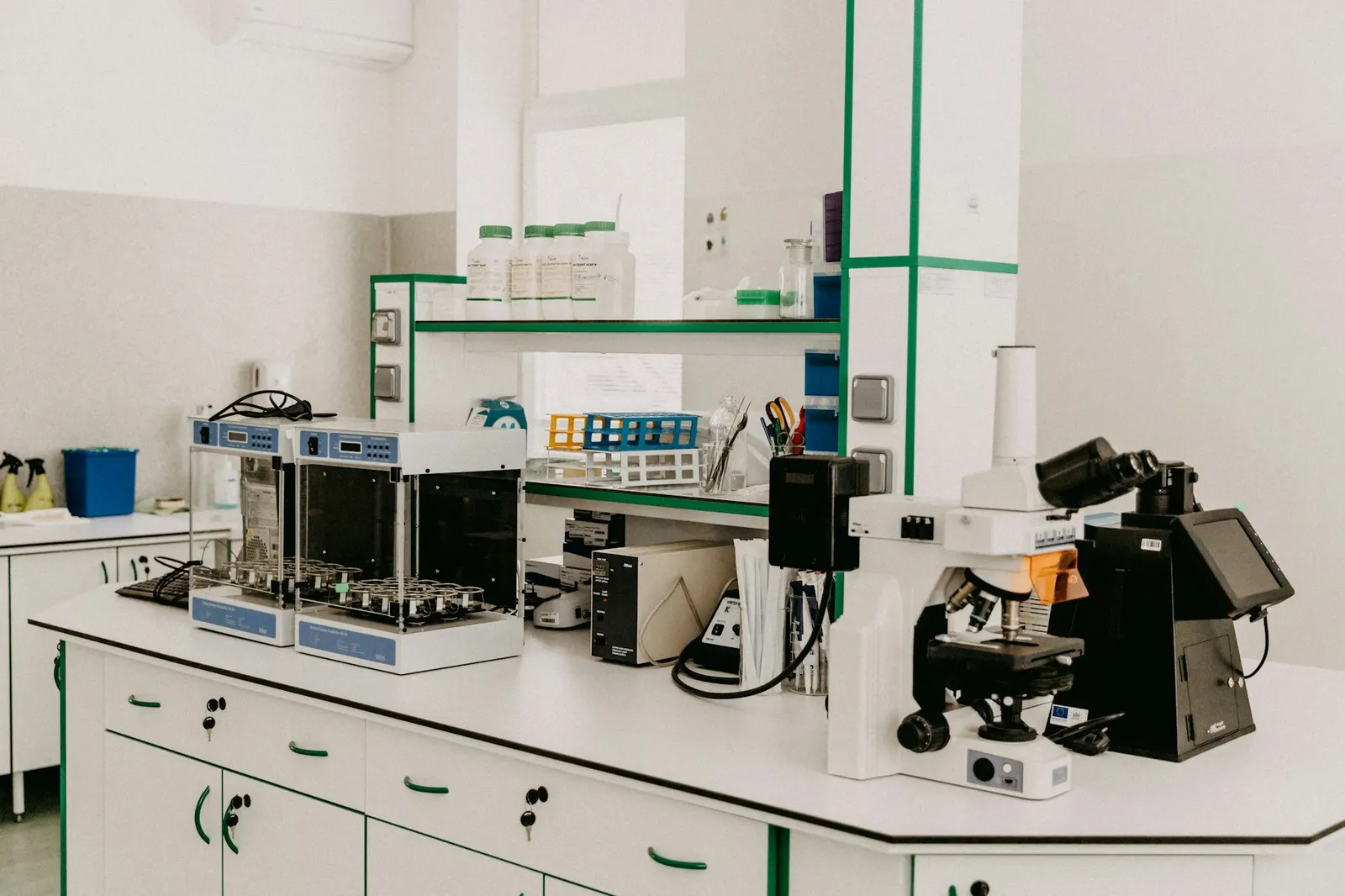
Lectures and exercises on real data: diffraction patterns, spectra, micrographs and thermal curves. When delivered on site, parts of the programme can be applied on the instruments available in the organisation’s laboratory. Delivered in person or online, in Arabic or English.
Questions
FAQ
Do we need to have all the instruments?
No. The programme is built on interpreting real data from each method, and practical work is added on whatever instruments the organisation’s laboratory has when the programme is delivered on site.
Can the programme focus on a particular type of material?
Yes. The examples and the case study can be built on the organisation’s own materials, such as ores, cement, polymers or catalysts, if it sends the centre samples of its data before the programme.
A programme tailored to your organisation
The duration and topics of the programme are adjusted to the organisation's needs, and it is delivered at its site, in a training hall arranged by the Center, or virtually.