
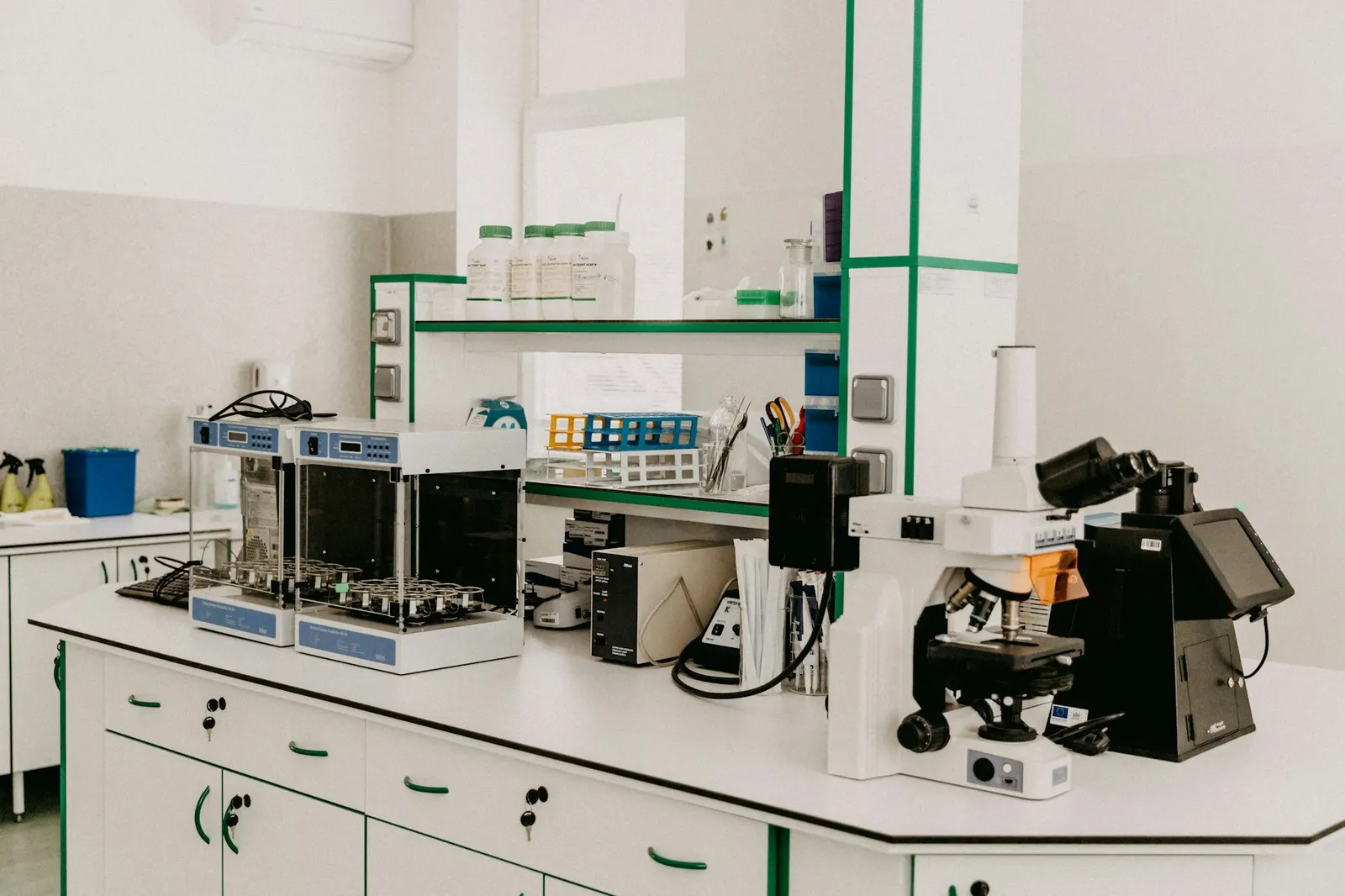
Laboratories
Inductively Coupled Plasma Spectrometry (ICP)
A programme in the determination of metals and trace elements by inductively coupled plasma spectrometry in both its forms, optical emission (ICP-OES) and mass spectrometry (ICP-MS), covering how the instrument works, sample preparation and digestion, interferences and their correction, and calibration and quality control.
Overview
About the programme
Duration
4 days
Training hours
12 hours
Delivery
Training room · Virtual · In the organisation’s laboratory
Language
Arabic or English
Objectives
Training outcomes
- Explain plasma generation and the components of an ICP instrument: sample introduction system, torch, radio-frequency coil and detection system.
- Compare ICP-OES and ICP-MS in detection limits, concentration range, interferences and operating requirements.
- Choose a digestion method suited to the sample matrix.
- Recognise and correct spectral and non-spectral interferences, including polyatomic interferences in ICP-MS.
- Set up calibration, use internal standards and apply quality control procedures.
Content
What the programme covers
Day 1: principles and the instrument
- Fundamentals of atomic emission and ionisation, and generating an argon plasma.
- The sample introduction system: peristaltic pump, nebuliser, spray chamber and torch, and axial and radial viewing in ICP-OES.
Day 2: ICP-OES and ICP-MS
- ICP-OES: the spectrometer, choice of emission lines and background correction.
- ICP-MS: the cones, the quadrupole mass analyser, the detector, and the collision/reaction cell.
- Comparing the two techniques and choosing the right one for the application.
Day 3: sample preparation and interferences
- Acid digestion on a hot plate and by microwave, and safety requirements when handling acids.
- Spectral interferences, matrix interferences, and polyatomic and isobaric interferences in ICP-MS, and how to correct them.
Day 4: calibration and quality control
- Calibration curves, internal standards, the method of standard additions, and detection limits.
- Quality control: blanks, calibration verification solutions, reference materials and spiked samples, with examples from US EPA methods 200.7 and 200.8.
- Routine maintenance of the torch, cones and sample introduction system, followed by the assessment.
Who it is for
Target audience
Chemists and analysts who operate, or will operate, ICP instruments in water, environmental, food, mining and industrial laboratories, and the supervisors of these laboratories.
Method
Delivery method
Lectures and demonstrations on real data and spectra, and exercises on calibration calculations and interference correction. When delivered on site, the practical work takes place in the organisation’s laboratory on its own instrument. Delivered in person or online, in Arabic or English.
Questions
FAQ
Does the programme cover both ICP-OES and ICP-MS?
Yes. It teaches the common principles and then the specifics of each technique, and the emphasis can be shifted towards the technique the organisation’s laboratory owns.
What level is required?
A background in analytical chemistry and general laboratory experience; previous operation of an ICP instrument is not required.
Is there a certificate?
Every participant who attends the programme and passes the assessment receives a certificate of completion from Technology Experts Training Center, licensed by the Technical and Vocational Training Corporation.
A programme tailored to your organisation
The duration and topics of the programme are adjusted to the organisation's needs, and it is delivered at its site, in a training hall arranged by the Center, or virtually.